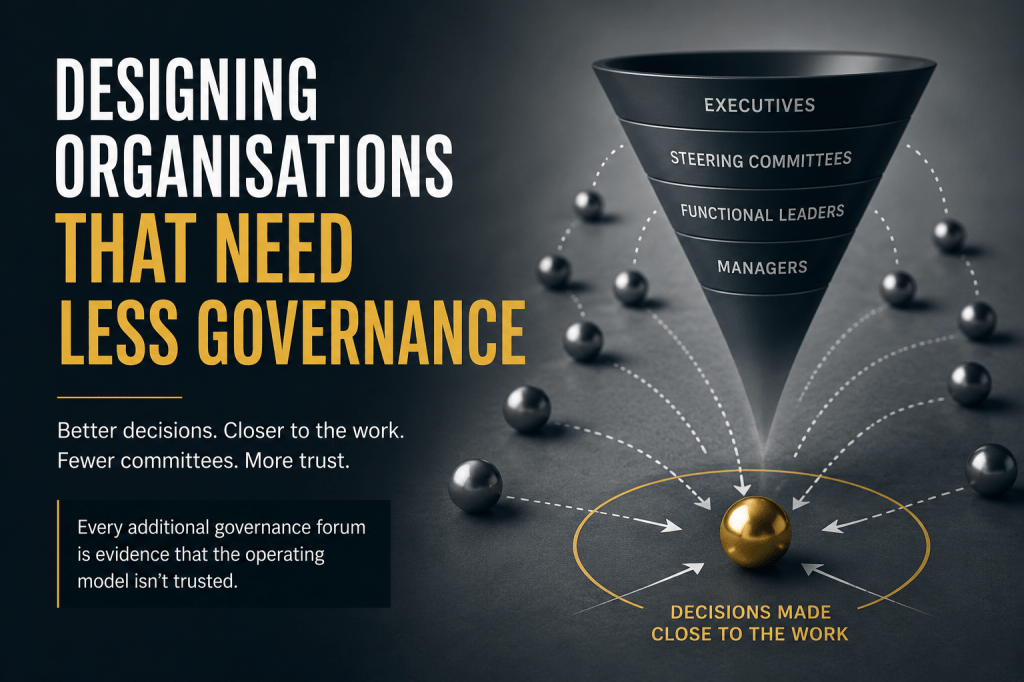
Every additional governance forum is evidence that the operating model isn’t trusted.
I wrote that sentence down after yet another discussion about whether a new Steering Committee should be established. The more I thought about it, the more I realised this wasn’t really an article about Steering Committees at all.
It’s about trust.
More specifically, it’s about whether we’ve designed our organisations to make good decisions without constantly pulling executives back into the room.
Let me be clear from the outset. This isn’t an argument against governance. Good governance is essential.
Large ERP implementations, enterprise-wide transformations, major acquisitions and highly regulated programs often deserve dedicated oversight. They involve significant investment, enterprise risk and decisions that genuinely sit beyond the authority of any one delivery team.
But somewhere along the way we’ve become conditioned to solve execution problems with governance. Projects become important, complexity increases, delivery slows. Our instinct is often to create another Steering Committee.
Rarely do we stop to ask whether the problem is actually our operating model.
Governance should be the last design decision
When an initiative spans multiple teams or functions, I often hear the same response.
“We’ll need a Steering Committee.”
I’m not convinced. Crossing organisational boundaries is usually an organisation design challenge, not a governance challenge.
Our first question shouldn’t be:
“Who needs a seat at the Steering Committee?”
It should be:
“Can we construct a single accountable team with the capability, authority and context to own this outcome?”
If the answer is yes, then our focus should be on strengthening that team—not creating another governance forum around it. Too often we skip straight to governance instead of investing in the conditions that make governance less necessary.
Autonomy isn’t granted. It’s designed.
Many organisations talk about empowering teams, I think we often misunderstand what that means.
Autonomy isn’t something leaders give. It’s something the organisation intentionally designs. Teams become genuinely autonomous when they have:
- Clear outcomes
- The right capability and experience
- Access to the information they need
- Defined decision rights
- Clear boundaries
- Measures of success
- Confidence that leaders trust them to make decisions within those boundaries
Without those things, autonomy becomes risky. With them, autonomy becomes one of an organisation’s greatest competitive advantages. Because good decisions happen closer to the work.
The hidden cost of too many Steering Committees
There’s another pattern I’ve noticed.
Many Steering Committees gradually become representative forums. Sales has a representative; Technology has a representative; Finance has a representative; Operations has a representative.
Everyone who contributed people or budget feels entitled to a seat at the table.
The discussion subtly shifts.
Instead of asking:
“What’s best for the enterprise?”
People begin asking:
“How does this affect my area?”
The Steering Committee slowly becomes a negotiation between business units rather than a forum for enterprise decision-making. That’s not governance. It’s stakeholder management.
We should lean more on an Executive Sponsor, shepparding the team and providing guiadance and advice, representing the enterprise as a whole. Their role is to balance customer outcomes, organisational capability, risk, investment and strategy—representing their peers at the executive table and their collective posistions.
The Decision Gravity Model
I’ve started thinking about organisations through a simple idea that I call Decision Gravity.
In some organisations, every meaningful decision seems to be pulled upwards. Teams seek approval, Managers escalate, Executives become the centre of gravity, Decision-making slows, Leadership becomes overloaded.
Teams become less accountable because they learn that someone higher up will ultimately decide.
High-performing organisations create a different kind of gravity.
Decisions naturally settle with the people closest to the work because those people have the capability, context, information and authority to make them well. Leadership isn’t measured by how many decisions executives make. It’s measured by how many good decisions they no longer need to make.
Figure 1 – The Decision Gravity Model
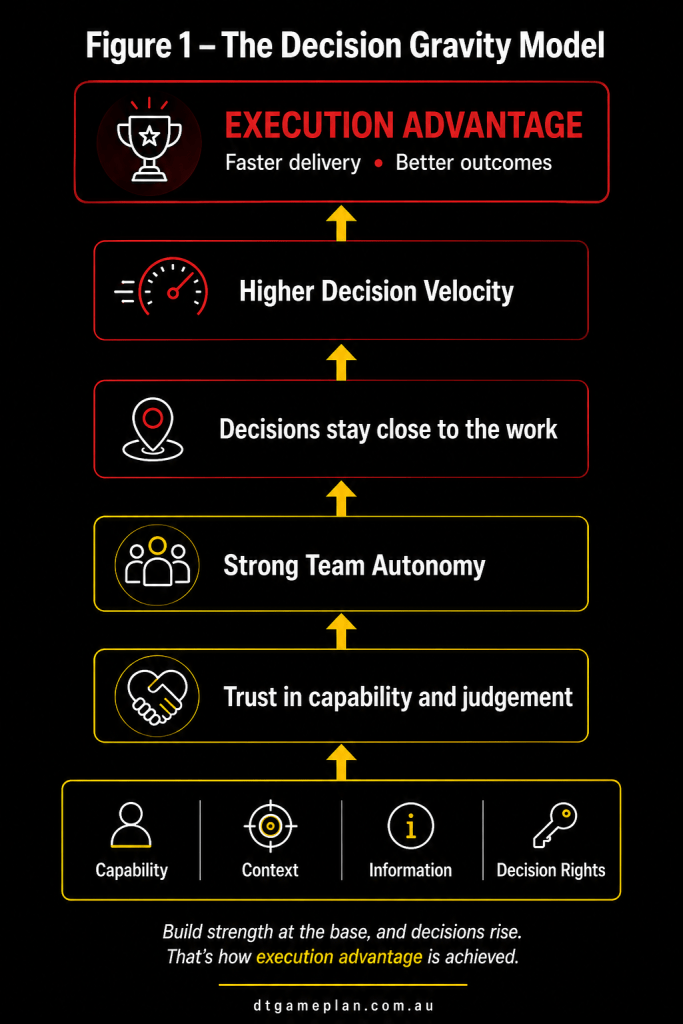
The purpose of an operating model isn’t simply to organise work. It’s to determine where decision gravity sits within the organisation. The stronger the capability and trust within teams, the less decision gravity pulls towards executives.
Steering Committees should exist because of the decisions they make
This is where I think we’ve lost our way. A Steering Committee shouldn’t exist because an initiative is important. It shouldn’t exist because multiple business units are involved. It shouldn’t exist because several leaders contributed people or funding.
It should exist because the nature of the decisions genuinely requires enterprise judgement. Before establishing another Steering Committee, I’d ask six questions.
| Question | If the answer is “Yes”… |
|---|---|
| Can a single accountable team be formed to own this outcome? | If yes, don’t create a Steering Committee yet. |
| Does the team have the capability to make the required decisions? | If not, invest in capability before adding governance. |
| Can decision rights be delegated further? | If yes, redesign the operating model first. |
| Are we solving a governance problem or an organisation design problem? | Be honest about which it is. |
| Will this forum make enterprise decisions that no delivery team has the authority to make? | If yes, a Steering Committee may be appropriate. |
| Could this be governed through the existing executive cadence? | If yes, avoid creating another forum. |
A maturity shift
Perhaps this is what separates mature operating models from immature ones.
| Lower maturity | Higher maturity |
| Escalate everything | Escalate exceptions |
| Executive approvals | Delegated authority |
| Governance-heavy | Trust-heavy |
| Status meetings | Decision forums |
| Heroic leaders | Capable teams |
| Information held at the top | Information available to those making decisions |
| Slow decision-making | High decision velocity |
| Executives solve operational problems | Executives solve strategic problems |
None of this suggests executives become less important.
Quite the opposite.
As organisations mature, executives become more valuable because they spend less time making operational decisions and more time making the few enterprise decisions that genuinely require their judgement.
Designing organisations that need less governance
The next time someone suggests creating another Steering Committee, pause for a moment. Ask yourself whether you’re solving a governance problem….or avoiding an operating model problem.
Have we built the right team?
Have we invested in capability?
Have we clarified decision rights?
Have we given people the context and information they need?
Have we designed the organisation so decisions naturally stay close to the work?
Only after we’ve exhausted those questions should additional governance become the answer. Because the best organisations I’ve worked with weren’t the ones with the most governance. They were the ones that had invested so deliberately in their people, their operating model and their leadership that they simply needed less of it.
And perhaps that’s the real test of organisational maturity. Not how many Steering Committees you can create. But how few you actually need.
Because every additional governance forum is evidence that the operating model isn’t yet trusted.


Leave a Reply